Key Takeaways
- Crucial challenges specific to coastal construction in the Outer Banks.
- Innovative techniques and advanced equipment tailored for coastal environments.
- The ongoing importance of safety and operational efficiency.
- The value brought by seasoned heavy lifting service providers.
The Outer Banks, NC, is renowned for its picturesque landscapes, but for builders and developers, the region’s changing tidal forces and unpredictable weather introduce considerable complexity to coastal construction projects. Beachfront infrastructure, renourishment initiatives, and storm recovery efforts all require precise, powerful heavy-lifting capabilities, particularly in sandy, shifting terrain. Choosing the right boom truck crane rental in Outer Banks, NC is vital for achieving both safe and efficient outcomes. Working with Albemarle Crane Service, a family-run company specializing in boom truck crane rentals for Outer Banks, NC, and surrounding regions, you tap into decades of hands-on experience and the latest in heavy machinery solutions. Albemarle Crane Service’s fleet is purpose-built for the demanding conditions present across Dare County and is trusted by contractors for its reliability and expertise in coastal applications.
As storms, erosion, and tides play a major role in shaping the coastline, any heavy lifting partner must be equipped to respond rapidly and adapt to the challenges at hand. Albemarle Crane Service stands out as an authority not only for its advanced, meticulously maintained equipment but also for its strategic planning and rapid mobilization across the barrier islands. With a proven track record across key service areas, including Kill Devil Hills, Nags Head, and Corolla, Albemarle’s deep local knowledge is critical for project safety, cost savings, and regulatory compliance.
Understanding Coastal Construction Challenges
Construction along the Outer Banks faces significant obstacles attributed to the forces of nature. The area is constantly shaped by hurricanes, nor’easters, and flooding, each capable of destabilizing job sites, endangering personnel, and damaging equipment. The collapse of coastal homes, most notably during the 2025 season along Cape Hatteras National Seashore, is a stark reminder of how crucial it is for builders to anticipate environmental volatility and invest in specialized lifting equipment.
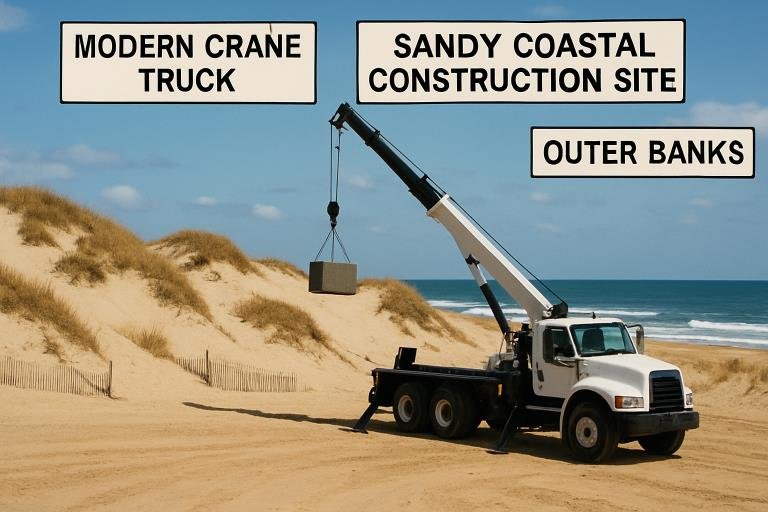
Unlike more stable inland projects, coastal projects require quick mobilization of cranes and boom trucks capable of operating on sand, dunes, and loose soil. Selecting service providers who prioritize site-specific planning, risk assessment, and compliance with strict safety regulations is the first step toward project success. Their familiarity with shifting regulations and regional permitting processes can be invaluable when weather delays necessitate quick pivots.
Advanced Heavy Lifting Techniques and Equipment
Over the past decade, heavy lifting in coastal construction has been revolutionized by an array of cutting-edge techniques and technological advancements. Chief among these innovations is input shaping, a process used in crane operations to reduce dynamic payload swinging—a significant hazard when wind and waves create unstable surfaces. By rapidly maneuvering loads with heightened precision, input shaping technology enables faster, safer installations for everything from steel pilings to modular building components.
The integration of attachable camera modules provides crane and boom truck operators with real-time visual feedback, significantly enhancing control and accuracy even in low-visibility or tight working spaces. When combined with remote-control features and robust model-predictive control systems, modern cranes can complete moves once deemed impossible, maintaining productivity and minimizing risk.
Ensuring Safety and Efficiency
Safety is the top priority when operating heavy equipment near the ocean, where high winds and sudden weather shifts can threaten even the most carefully managed sites. Today’s model predictive control systems analyze an array of sensor inputs to keep loads within safe operating envelopes. These systems not only detect dangerous swings or overloads, but also allow operators to adapt lifting protocols as conditions change, ensuring efficiency is not sacrificed for caution.
The most successful projects balance speed with respect for nature’s unpredictability. By investing in regular maintenance and specialized employee training, reliable crane services can proactively address potential technical failures and enforce industry-leading safety standards on every lift.
The Role of Experienced Service Providers
Successful coastal projects rely on the expertise and local knowledge of specialized service providers. Albemarle Crane Service exemplifies what sets an exceptional partner apart: a commitment to customer satisfaction, a safety-first mentality, and the agility to manage urgent, complex lifts under tight timelines. Their ability to tailor solutions for dock repairs, bridge construction, home relocation, and disaster recovery has made them a go-to choice for Outer Banks contractors and municipalities alike.
Future Trends in Coastal Heavy Lifting
As the construction sector continues to innovate, expectations are rising for even more advanced, autonomous heavy-lifting solutions. New developments in aerial manipulation, specifically the cooperative handling of cable-suspended loads by fleets of drones, could soon enable unprecedented flexibility and accessibility in challenging coastal sites. These advancements will support the ever-present need to adapt quickly to rapidly changing environments and evolving project demands.
Conclusion
The unique landscape of the Outer Banks demands heavy-lifting partners who understand both practical and environmental complexities. Advanced techniques, investment in safety, and collaboration with experts such as Albemarle Crane Service remain cornerstones of enduring, resilient coastal projects. As technology evolves and local expertise deepens, the Outer Banks community can look forward to infrastructure built to withstand the forces of nature, today and into the future.
Frequently Asked Questions (FAQ)
What are the primary challenges of heavy lifting in coastal construction?
Coastal projects must address unpredictable weather, high winds, erosion, and unstable soils, which can disrupt schedules and pose safety risks for material handling and lifting operations.
How do advanced techniques like input shaping improve crane operations?
Input shaping technology helps minimize payload swinging during crane operations, significantly reducing the risk of accidents and improving the speed and precision of heavy lifts.
Why is it important to work with experienced service providers in coastal projects?
Specialized, locally experienced providers like Albemarle Crane Service understand the environmental and regulatory specifics of the Outer Banks, offering reliable equipment and expert crews for smooth, safe project execution.
What role does technology play in enhancing heavy lifting safety?
Advanced technology, including real-time monitoring, predictive control systems, and visual guidance, allows operators to execute lifts precisely, anticipate hazards, and adapt methods as site conditions change.
Are there any recent examples of successful heavy-lifting projects in the Outer Banks?
Notably, the Rodanthe Bridge build and the Buxton home relocation have recently demonstrated the successful application of next-generation heavy-lifting strategies in the coastal region.