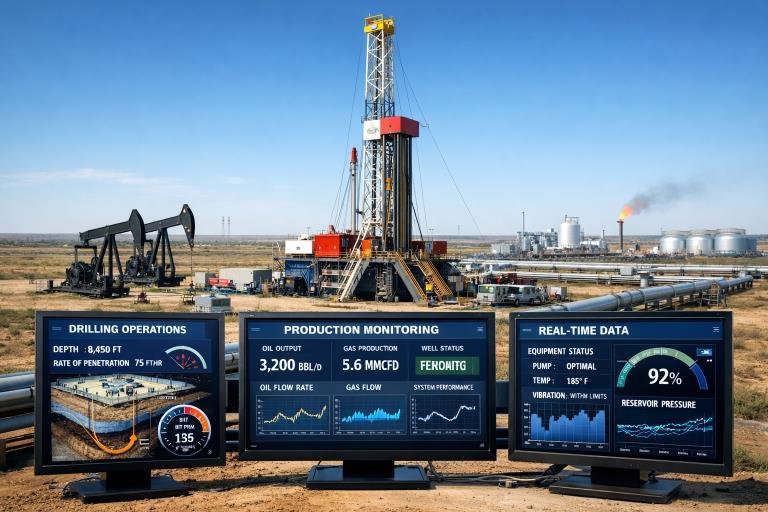
Key Takeaways
- Integration of advanced technologies like AI and cloud computing is revolutionizing oil exploration.
- Companies are focusing on near-field exploration to optimize existing infrastructure.
- Strategic partnerships and lean operations are becoming essential for success.
Oil field exploration has undergone significant transformations in recent years, driven by technological advancements and evolving industry strategies. These modern approaches aim to enhance efficiency, reduce costs, and minimize environmental impact.
Embracing Advanced Technologies
The adoption of cutting-edge technologies is rapidly reshaping the oil exploration landscape. Companies now rely on advanced cloud computing platforms to process massive volumes of geological data with greater speed and efficiency. This capability enables faster analysis, more informed decision-making, and a shorter timeline from initial exploration to full-scale production. As a result, operations become more cost-effective while minimizing delays in resource development.
One of the most significant advancements is the use of machine learning algorithms to interpret complex datasets, including seismic readings, reservoir properties, and satellite imagery. These AI-driven systems can detect subtle patterns and relationships that are often missed through traditional analysis, improving the accuracy of subsurface mapping and increasing the chances of successful drilling. For businesses seeking experienced partners in this evolving industry, working with reliable oil well drilling contractors ensures access to both advanced technology and the technical expertise needed to maximize exploration outcomes.
Additionally, digital twin technology is now being employed to create virtual replicas of oil fields. These digital representations allow engineers and geoscientists to test various exploration and production strategies in a risk-free virtual environment before deploying them in the real world. This innovation helps in optimizing drilling plans, forecasting reservoir performance, and preventing costly operational errors.
Focus on Near-Field Exploration
To mitigate risks and costs, many oil and gas companies are concentrating on near-field or infrastructure-led exploration (ILX). This strategy involves exploring areas adjacent to existing operations, leveraging current infrastructure to maximize resource recovery. ILX drilling has demonstrated higher success rates compared to traditional exploration methods, making it a vital approach in today’s market.
This approach not only reduces the need for new infrastructure investment but also offers a more predictable regulatory and operational environment, since companies are familiar with the region and its geological challenges. In some cases, they can utilize pre-existing pipelines, production facilities, and transport frameworks, resulting in a significant reduction of both CapEx and OpEx.
Furthermore, near-field exploration can unlock untapped or overlooked reserves that may have been uneconomical to develop under previous market conditions or technological limitations. As oil prices fluctuate and new extraction methods emerge, these smaller or more complex accumulations become increasingly viable.
Strategic Partnerships and Lean Operations
Smaller exploration and production companies are adopting lean, nimble organizational structures to remain competitive. By focusing on core competencies and forming strategic partnerships, these companies can efficiently manage resources and adapt to market fluctuations. This approach emphasizes the importance of geology and prioritizes assets with significant potential.
Forming alliances with service providers, local operators, and technology firms allows companies to pool their expertise and share risks associated with frontier exploration. Collaborative ventures can also foster innovation, as different partners bring unique insights, proprietary tools, and best practices to the table. Industry consortia often invest in shared research programs, such as joint seismic surveys or basin modeling, further reducing individual expenditures and enhancing collective knowledge.
Lean operations go hand-in-hand with digital transformation, as automation and remote monitoring reduce overhead and boost productivity. For example, using autonomous drilling rigs and remote analytics hubs, operators can manage multiple assets with a much smaller on-site footprint, which is especially valuable in remote or politically sensitive regions.
Data-Driven Decision Making
The integration of artificial intelligence (AI) and geographic information systems (GIS) is transforming traditional exploration processes into proactive, agile systems. These technologies enable rapid evaluation of large datasets, allowing companies to identify promising prospects more quickly and accurately.
Big data analytics helps interpret seismic, geological, and production data streams in real-time. With advanced visualization tools, multidisciplinary teams can easily collaborate, analyze past successes and failures, and model new exploration scenarios. For example, machine learning can identify subtle geological features or hydrocarbon indicators by training on massive datasets, continuously refining and improving its predictive capabilities.
Moreover, probabilistic risk analysis and digital dashboards are increasingly used to inform investment decisions, monitor project milestones, and optimize exploration portfolios. These data-driven strategies not only enhance operational efficiency but also support compliance efforts in an increasingly regulated environment.
Environmental Considerations
Modern exploration techniques also prioritize environmental sustainability. By utilizing advanced technologies and focusing on near-field exploration, companies can minimize their ecological footprint. This approach aligns with global efforts to balance energy needs with environmental stewardship.
Enhanced satellite monitoring and real-time environmental sensors help companies detect and address possible sources of environmental impact, such as methane leaks or unintentional spills. Environmental impact assessments have become more data-centric and predictive, allowing companies to proactively avoid sensitive habitats or mitigate risks before full-scale operations commence.
Additionally, many operators are investing in carbon management strategies, such as carbon capture and storage (CCS) or the use of lower-carbon drilling fluids. Integrating these solutions from the earliest stages of exploration helps ensure compliance with evolving regulations and improves the overall sustainability credentials of new projects.
Conclusion
The oil and gas industry is at a pivotal point, with modern approaches to exploration offering pathways to increased efficiency and sustainability. By embracing technological advancements, focusing on strategic partnerships, and prioritizing environmental considerations, companies can navigate the complexities of today’s energy landscape.
As the demand for cleaner energy sources grows, the industry is also exploring the integration of renewable resources alongside traditional operations. Hybrid energy hubs, combining oil, gas, wind, and solar generation, are emerging in key regions, presenting new business models and exploration opportunities. These innovations suggest that the future of exploration will be not only about hydrocarbon discovery, but also about adaptability, resilience, and responsible resource management.
Ultimately, the evolution of oil field exploration reflects a broader industry shift: balancing profitability with planetary stewardship. With smarter tools, stronger collaborations, and a deepening commitment to sustainable practices, the sector is well-positioned to contribute meaningfully to global energy needs well into the future.