Defining Specialized Logistics Solutions and Core Cargo Capabilities
In an increasingly interconnected global economy, the movement of goods has become a complex dance. While standard freight services handle most cargo efficiently, certain high-value, sensitive, or time-critical products demand a far more sophisticated approach. This is where specialized logistics solutions become indispensable. They are the backbone for industries where precision, security, and compliance are non-negotiable.
Imagine transporting life-saving medical treatments, irreplaceable works of art, or fragile semiconductor components across continents. Standard procedures simply won’t suffice. These unique challenges require tailored strategies, advanced equipment, and expert coordination to ensure integrity and timely delivery.
Throughout this article, we will delve into the intricacies of specialized logistics. We will define what these solutions entail, identify the industries that rely on them most, and examine the critical services and advanced technologies that ensure the safe, compliant, and timely delivery of even the most challenging shipments. From safeguarding precious pharmaceuticals to moving delicate electronics, understanding specialized logistics is key to navigating today’s complex supply chains, especially when dealing with global movements that often require expert international freight forwarding services. Join us as we explore how these specialized approaches mitigate risks and unlock new possibilities in logistics.
Specialized logistics solutions go beyond conventional shipping, offering bespoke services designed to meet the unique demands of high-value, sensitive, or time-critical cargo. Unlike general freight, which prioritizes volume and cost-efficiency, specialized logistics prioritizes precision, security, and the integrity of the goods. These solutions are tailored for products that cannot withstand standard handling, fluctuating environmental conditions, or delays.
Typically, these services handle a diverse range of high-value or sensitive goods, including:
- Laboratory Equipment:Delicate instruments, often requiring climate control and vibration dampening.
- Fine Art:Irreplaceable pieces needing careful handling, specific environmental conditions, and enhanced security.
- Sensitive Electronics:Components like semiconductor wafers and integrated circuits that are susceptible to static, vibration, and contamination.
- Medical and Pharmaceutical Goods:Life-saving drugs, vaccines, and advanced therapies that demand strict temperature control, sometimes down to cryogenic levels.
- Fragile Items:Any goods that require exceptional care to prevent damage during transit.
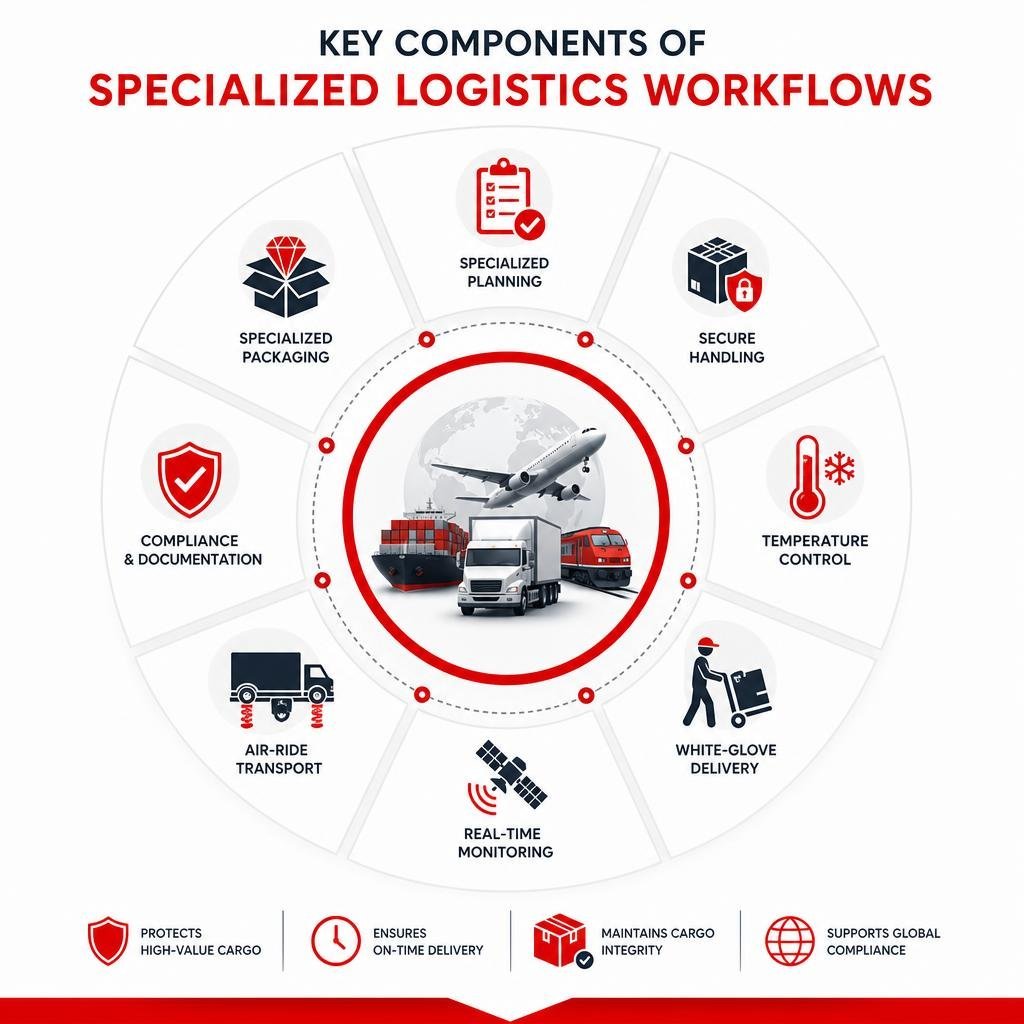
Key services offered within specialized logistics include:
- Temperature-Controlled Shipping:Maintaining precise temperature ranges, from ambient to ultra-cold (e.g., -80°C) or cryogenic (-196°C) conditions, crucial for pharmaceuticals and biological samples.
- White-Glove Delivery:Premium service involving careful handling, placement, and often installation of goods at the final destination.
- Air-Ride Suspension:Utilizing specialized vehicles equipped with air-ride technology to absorb shocks and vibrations, protecting fragile items from road impacts.
- Secure Transportation:Implementing advanced security measures, including bonded couriers, armed escorts, and tamper-evident seals, for high-value or high-risk shipments.
The distinction between standard and specialized logistics is critical. While a standard carrier might move a pallet of non-perishable goods, a specialized provider meticulously plans every detail for a unique shipment.
Consider the fundamental differences:
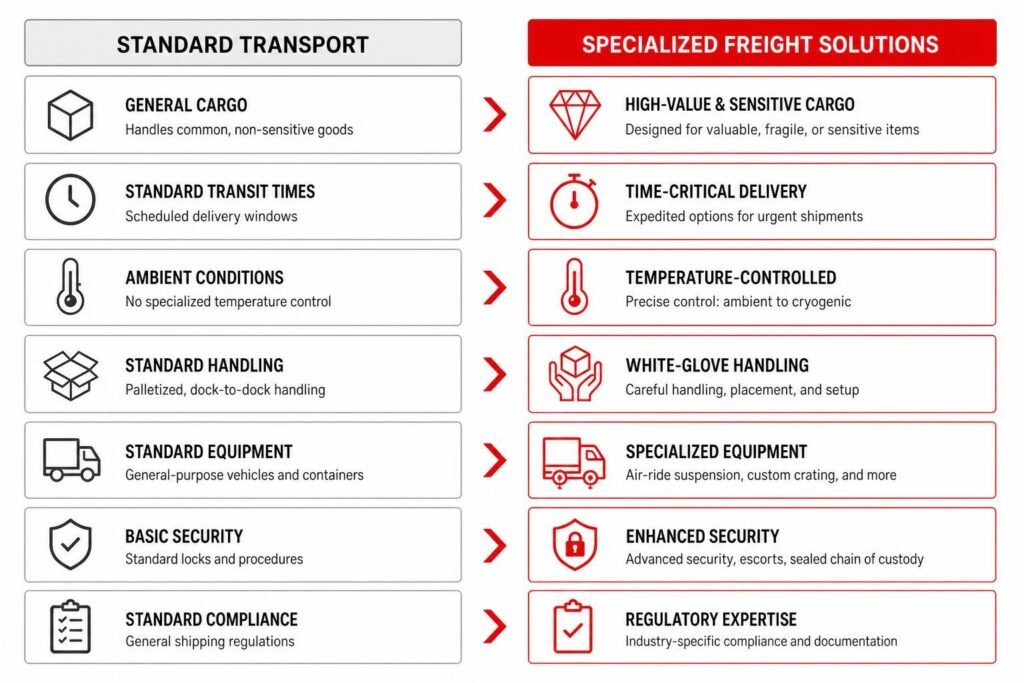
This tailored approach ensures that whether it’s a delicate piece of lab equipment or a time-sensitive medical sample, the cargo arrives in perfect condition, exactly when and where it’s needed.
White-Glove Handling and Precision Delivery Protocols
At the heart of specialized logistics is the concept of white-glove service, which signifies an elevated level of care and attention. This isn’t merely about careful handling; it encompasses a comprehensive suite of services designed to ensure the seamless delivery and often integration of sensitive items.
White-glove delivery frequently includes over-the-threshold delivery, where items are not just dropped at a loading dock but brought inside the premises to a specific room or location. This is particularly vital for industries like healthcare, where medical equipment needs to be placed directly into an operating room or lab, or for retail, where fixtures might need to be set up on a sales floor.
Beyond placement, certified installation teams are often part of the package. For instance, in retail logistics, specialized providers manage the nationwide placement and setup of point-of-purchase (P-O-P) displays. This requires not only transportation but also skilled professionals who can assemble and install complex displays according to precise specifications. Similarly, for scientific or medical equipment, installation might involve specialized rigging and calibration.
Before any movement, a crucial step is site feasibility mapping and readiness assessments. This involves evaluating the destination site for accessibility, space, and any specific requirements, ensuring that the delivery and installation process is smooth and free of unexpected obstacles. For ultra-sensitive or high-security cargo, protocols can extend to direct planeside transfers, bypassing standard airport conveyor systems to minimize handling risks and dwell time. This meticulous approach ensures that every step, from pickup to final placement, is executed with utmost precision.
Cold Chain and Environmental Control Operations
For many high-value and sensitive goods, maintaining a consistent environment throughout transit is paramount. This is the domain of cold chain and environmental control operations, a critical component of specialized logistics. Products such as pharmaceuticals, biological samples, and certain chemicals are highly susceptible to temperature fluctuations, humidity, and even condensation.
Specialized logistics providers employ validated thermal packaging solutions, often custom-engineered to protect products across diverse climate zones. This packaging can range from active temperature-controlled units that maintain a precise range to passive solutions utilizing phase-change materials or dry ice. For ultra-cold requirements, liquid nitrogen (LN2) packaging and cryogenic storage are deployed, ensuring temperatures as low as -196°C for sensitive biological materials like cell and gene therapies.
Beyond just temperature, managing humidity control and condensation prevention is equally vital. For example, some confectionery products are sensitive to moisture and can be damaged by condensation during cross-country shipping. Specialized packaging is designed to mitigate these ambient risks, protecting the product’s integrity.
To further minimize exposure to environmental variations, narrow delivery windows are often pre-arranged. These short, precise delivery times, sometimes as brief as two hours, reduce the duration that sensitive items spend outside a controlled environment during final-mile handoffs. This comprehensive approach to environmental control ensures that even the most delicate cargo arrives in pristine condition, regardless of external conditions.
Critical Industry Applications and High-Value Freight Management
Specialized logistics solutions are not a niche service but a fundamental requirement for industries where the stakes are exceptionally high. These sectors deal with products that are either intrinsically valuable, critical for human well-being, or essential for complex technological processes.
Industries that benefit most include:
- Healthcare Logistics:Encompassing everything from routine medical supplies to complex hospital relocations and the transport of life-saving medical devices.
- Cell and Gene Therapy:A rapidly evolving field requiring unparalleled precision for “vein-to-vein” delivery of personalized medicines.
- Nuclear Medicine:Dealing with radioactive isotopes that demand stringent safety protocols and time-critical transport due to short half-lives.
- Semiconductor Transport:Moving extremely fragile and sensitive electronic components, often requiring cleanroom environments and anti-vibration measures.
- Retail Fixtures:Managing the complex logistics of deploying and installing P-O-P displays and store fittings nationwide.
For these sectors, the cost of failure—whether it’s a damaged semiconductor wafer, a compromised gene therapy, or a delayed radioisotope—can be catastrophic, far outweighing the premium associated with specialized logistics. This makes robust, tailored solutions an absolute necessity.
Life Sciences and Cell & Gene Therapy Logistics
The life sciences sector, particularly the burgeoning field of cell and gene therapy, represents perhaps the pinnacle of specialized logistics demands. These therapies are often personalized, patient-specific treatments, making their safe and timely transport a matter of life and death.
A core principle here is vein-to-vein tracking, which mandates a fully documented and unbroken chain of identity and custody from the moment a patient’s cells are collected (the “vein”) until the therapy is administered back to the patient. This total traceability is non-negotiable for autologous therapies (using a patient’s own cells) and ex vivo treatments. Any breach in this chain can render the therapy unusable.
Logistics providers in this space utilize 24/7 global control tower oversight and advanced GPS tracking with smart packaging to monitor shipments continuously. They must also possess deep regulatory expertise to navigate the complex international requirements for transporting biologics. In urgent situations, such as the need to return grounded aircraft to operation due to a critical part failure, Aircraft On Ground (AOG) air freight principles are applied, leveraging Next Flight Out (NFO) services and dedicated charters to ensure time-critical biologics reach their destination without delay. The speed of logistics must match the speed of scientific discovery, as patients simply cannot wait.
Electronics, Semiconductors, and Regulated Cargo
The electronics and semiconductor industries present another set of unique challenges for specialized logistics. Products like semiconductor wafers and IC equipment are incredibly delicate, susceptible to static discharge, vibration, contamination, and even minute dust particles. Their transport often requires cleanroom protocols to maintain sterility and prevent damage.
For international shipments, compliance is paramount. Companies often adhere to standards like TAPA (Transported Asset Protection Association), which sets global benchmarks for supply chain security. AEO (Authorized Economic Operator) certification can streamline customs processes, leveraging expedited “green-pass” clearance for trusted traders.
Handling regulated cargo, including certain chemicals used in semiconductor manufacturing, also falls under this specialized umbrella. This can involve hazardous materials logistics, ensuring safe storage, handling, and transportation in compliance with strict international regulations. For example, some semiconductor raw materials require cold-chain hazardous chemical shipping, adding another layer of complexity.
A unique aspect of semiconductor logistics involves navigating customs inspections for sensitive, vacuum-sealed cargo. Providers must prepare detailed documentation and coordinate with customs officials to prevent breaking vacuum seals, which could compromise the product. This precision extends to every detail, including the declaration of all packaging materials, even empty cartons, for cross-border movements.
Advanced Technologies Powering Specialized Logistics Solutions
The precision and reliability demanded by specialized logistics would be impossible without cutting-edge technology. These solutions leverage a suite of advanced tools to provide unparalleled visibility, control, and efficiency across complex supply chains.
At the forefront is real-time GPS tracking, often combined with 4G/5G sensors embedded in packaging or vehicles. This allows for continuous, minute-by-minute monitoring of a shipment’s location, speed, and environmental conditions. This data feeds into sophisticated control towers, which act as central command centers, providing 24/7/365 oversight. These control towers can integrate live weather, aircraft performance, and real-time flight data to optimize routing and proactively identify potential disruptions.
Smart warehousing solutions further enhance specialized logistics. These facilities utilize automation for storage and retrieval, ensuring optimal conditions and rapid access to goods. IoT telemetry devices monitor critical parameters like temperature, humidity, shock, and light exposure, transmitting data instantly to the control tower. This continuous data flow enables predictive rerouting and proactive interventions, such as adjusting a delivery schedule if a vehicle encounters unexpected delays or environmental shifts.
This technological integration transforms logistics from a reactive process into a highly proactive and data-driven operation, ensuring that even the most sensitive shipments are protected and delivered on time.
Integrating Smart Warehousing and Real-Time Visibility into Specialized Logistics Solutions
Smart warehousing and real-time visibility are not just buzzwords; they are operational imperatives for specialized logistics. In these environments, every item is tracked, every condition monitored, and every process optimized for maximum efficiency and security.
Automated storage and retrieval systems within smart warehouses minimize human handling, reducing the risk of damage or error for fragile items. These systems are often integrated with inventory management software, ensuring precise stock control and rapid order fulfillment. The goal is to achieve exceptional operational accuracy, with some providers boasting rates as high as 99.8% for monthly shipments.
The concept of 24/7/365 monitoring extends from transit to storage. Environmental condition logging within warehouses ensures that temperature, humidity, and other critical factors are consistently maintained, especially for cold chain products. This continuous oversight is crucial for maintaining the integrity of sensitive goods.
Upon delivery, electronic proof of delivery (ePOD) systems provide instant confirmation of receipt, often within minutes, complete with timestamps and digital signatures. This rapid feedback loop is vital for time-critical shipments and for maintaining an unbroken audit trail. The combination of smart warehousing and comprehensive real-time visibility provides an unparalleled level of control and assurance, making specialized logistics truly reliable.
Cross-Border Compliance and International Supply Chain Optimization
Navigating international borders with specialized cargo adds layers of complexity, making cross-border compliance a cornerstone of effective specialized logistics. Each country has its own unique customs regulations, import/export duties, and specific requirements for sensitive goods.
Specialized providers excel in managing intricate customs clearance protocols. This includes preparing meticulous documentation for every item, even packaging materials. For extremely sensitive items like vacuum-sealed semiconductor components, specific procedures are in place. For example, declarants might submit official explanations requesting that vacuum seals remain intact during inspection, with brokers coordinating to prevent seal breaches where permitted. This level of detail is critical to protect product integrity.
Another challenge is managing split customs declarations. A single declaration form often has a limit on the number of distinct items (e.g., 50 items). Shipments exceeding this limit must be split into multiple declarations, requiring careful coordination to avoid delays. Leveraging certifications like AEO can help expedite this process, allowing for “green-pass” customs clearance.
For high-value or regulated international shipments, bonded couriers and priority air charters are often employed. These services ensure dedicated transport and expedited processing. Multimodal transit solutions, combining air and ground transport, are strategically planned to optimize speed and cost. For instance, a 1.5-day air-land multimodal transit time might be achieved for routes between Hong Kong and mainland China, or 2.0 days for Taiwan routes, highlighting the efficiency gained through optimized international supply chain design. This meticulous approach ensures that global movements are not only efficient but also fully compliant with all international trade regulations.
Overcoming Challenges with Specialized Logistics Solutions
The very nature of specialized logistics implies confronting and overcoming significant challenges. These are not standard shipping hurdles but intricate problems demanding tailored solutions and robust contingency planning.
One common challenge is road vibration damage. Fragile items, if not properly secured and transported in vehicles with air-ride suspension, can suffer irreversible damage from the constant jostling of long-distance travel. Similarly, time-critical delays can have severe consequences, especially for items with short shelf lives like radioisotopes or life-saving therapies. A delay of even a few hours can render a shipment unusable.
External factors also pose significant challenges. Geopolitical conflict, as seen in cases of transporting autologous therapies through volatile regions, demands extreme security measures and flexible routing. Facility power outages can threaten temperature-sensitive samples, necessitating emergency backup refrigeration and rapid response protocols. For high-value goods, the risk of theft or tampering requires robust high-security risk mitigation strategies.
Specialized logistics providers are experts at anticipating these challenges and implementing proactive measures to ensure the safe and timely delivery of goods, even under the most demanding circumstances.
Managing Fragile and High-Risk Shipments Under Extreme Conditions
When shipments are not just valuable but also fragile or high-risk, the management protocols become exceptionally stringent. Protecting these items under extreme conditions requires a multi-faceted approach.
Tamper-evident seals are a basic but critical component, providing immediate visual confirmation if a package has been opened or interfered with. For the highest security needs, armed escorts may accompany shipments, particularly for high-value electronics or pharmaceuticals. Shock sensors are often integrated into packaging or vehicles to record any impacts that could potentially damage fragile contents, providing an audit trail and allowing for immediate inspection upon arrival.
In cold chain logistics, unexpected events like power outages necessitate emergency backup refrigeration systems or immediate transfer to alternative controlled environments. For time-critical and high-security air freight, direct airport tarmac loading bypasses standard cargo handling facilities, reducing both exposure time and the risk of mishandling. This comprehensive approach minimizes vulnerabilities and ensures the integrity of the most sensitive cargo, no matter the external challenges.
Risk Management Strategies in Specialized Logistics Solutions
Effective risk management is not an afterthought in specialized logistics; it’s an integral part of the planning and execution from the outset. Providers employ a range of strategies to safeguard shipments and ensure compliance.
Adherence to international quality standards like ISO 9001 compliance ensures that processes are rigorously defined, documented, and consistently followed. This provides a framework for quality assurance and continuous improvement. For high-value shipments, securing high-limit liability coverage, sometimes up to $10 million, offers financial protection against unforeseen events.
Regulatory trade alignment is crucial for international shipments, ensuring that all necessary permits, licenses, and declarations are in order to prevent customs delays or penalties. This includes understanding specific regulations for hazardous materials, controlled substances, or dual-use technologies.
Proactive contingency planning is perhaps the most vital risk management strategy. This involves anticipating potential disruptions—from weather events and mechanical failures to geopolitical instability—and having pre-defined alternative routes, backup equipment, and emergency protocols ready for immediate deployment. Finally, maintaining unbroken audit trails for every step of the logistics process provides complete transparency and accountability, crucial for compliance and for demonstrating due diligence, especially in highly regulated industries.
Frequently Asked Questions
What types of products require specialized logistics solutions?
Specialized logistics solutions are essential for items that are sensitive, high-value, time-critical, or require specific environmental controls. This typically includes sensitive laboratory equipment, irreplaceable fine art, advanced cell and gene therapies, radioactive isotopes, delicate semiconductor wafers, and high-value electronics.
How do specialized logistics providers manage strict cold chain standards?
Providers manage strict cold chain standards through a combination of measures: utilizing validated liquid nitrogen containers for cryogenic temperatures, employing active temperature-controlled units for specific ranges, deploying continuous thermal sensors to monitor conditions, and using specialized packaging engineered to prevent moisture and condensation. They also implement 24/7 monitoring and contingency plans for power outages.
How are high-value shipments secured during international transport?
High-value international shipments are secured through multiple layers of protection: using bonded couriers, implementing direct planeside loading to bypass standard airport handling, utilizing TAPA-certified vehicles and facilities for enhanced security, applying tamper-evident sealing, and maintaining continuous 24/7/365 control tower monitoring with real-time tracking and communication.
Conclusion
In the intricate world of global commerce, specialized logistics solutions stand as the indispensable bridge for industries dealing with the most challenging and critical shipments. From the delicate dance of moving semiconductor wafers to the life-saving urgency of transporting advanced cell and gene therapies, these solutions provide the precision, security, and compliance that standard logistics simply cannot offer.
We have explored how end-to-end oversight, driven by sophisticated technological integration like real-time tracking and smart warehousing, ensures unparalleled visibility and control. We’ve seen how expert providers navigate the complexities of cross-border compliance and mitigate risks ranging from road vibration to geopolitical conflict. By understanding and leveraging these specialized approaches, businesses can build robust supply chain resilience, effectively future-proofing supply chains against unforeseen disruptions.
Specialized logistics is about more than just moving goods; it’s about safeguarding integrity, ensuring continuity, and delivering on promises where failure is not an option. By embracing these risk mitigation best practices, companies can confidently transport their most valuable assets across the globe, knowing they are in expert hands.