Strategic Foundation: Distinguishing Strategy, Tactics, and Media Mix
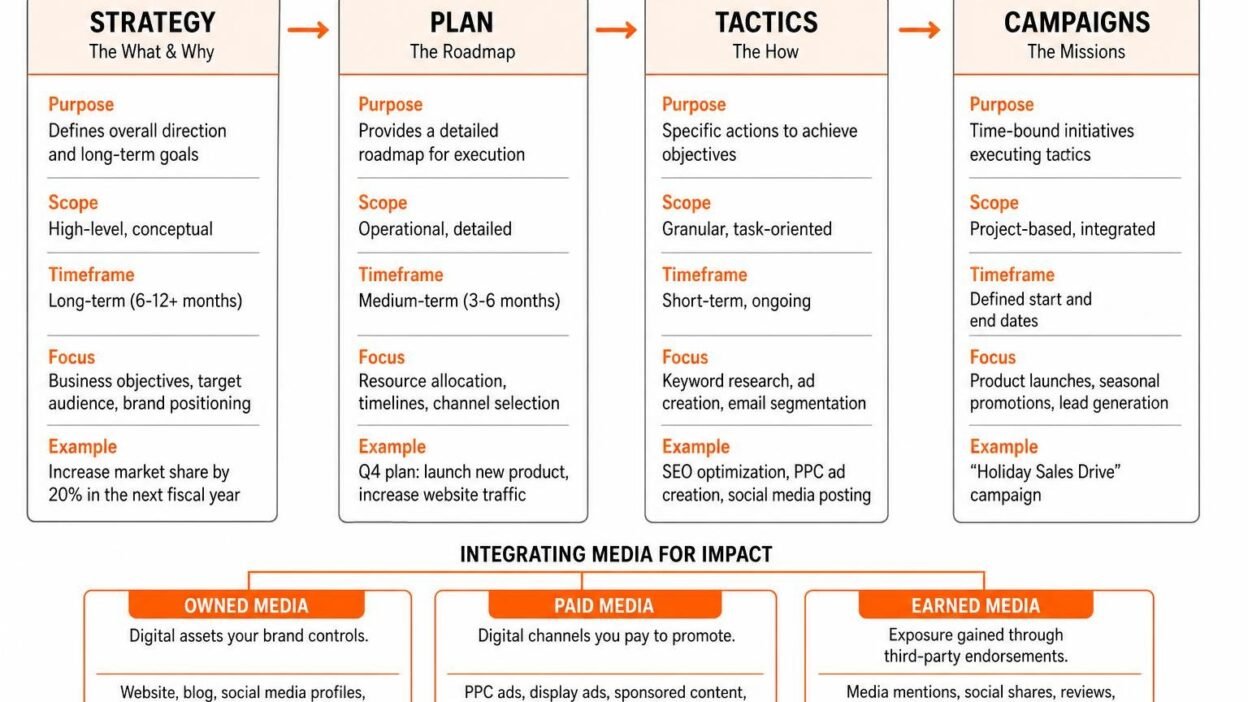
At the heart of successful digital marketing lies a clear understanding of its foundational elements: strategy, tactics, and the diverse media channels available. We often encounter these terms used interchangeably, but recognizing their distinct roles is crucial for effective implementation. A digital marketing strategy serves as your overarching, long-term blueprint – a high-level plan that defines your objectives, identifies your target audience, and outlines the broad framework for all your marketing activities across digital channels. It’s the “what” and the “why” behind your efforts, guiding your organization toward specific business goals.
In contrast, digital marketing tactics are the specific, granular actions you undertake to achieve the objectives set forth in your strategy. These are the “how” – the tools and methods you deploy. For instance, if your strategy is to increase brand awareness among young professionals, a tactic might be running targeted Instagram ad campaigns or optimizing blog content for specific keywords. Digital marketing campaigns then act as time-bound initiatives that activate these tactics, bringing them to life with specific messaging, budgets, and timelines. A campaign might involve a series of social media posts, email newsletters, and paid ads all focused on promoting a new product launch over a month. The strategy provides the direction, the tactics are the specific maneuvers, and the campaigns are the organized missions.
To further clarify, consider this comparison:
Feature Digital Marketing Strategy Digital Marketing Plan Digital Marketing Tactics Digital Marketing Campaigns Purpose Defines overall direction and long-term goals Provides a detailed roadmap for execution Specific actions to achieve objectives Time-bound initiatives executing tactics Scope High-level, conceptual Operational, detailed Granular, task-oriented Project-based, integrated Timeframe Long-term (6-12+ months) Medium-term (3-6 months) Short-term, ongoing Defined start and end dates Focus Business objectives, target audience, brand positioning Resource allocation, timelines, channel selection Keyword research, ad creation, email segmentation Product launches, seasonal promotions, lead generation Example Increase market share by 20% in the next fiscal year Q4 plan: launch new product, increase website traffic SEO optimization, PPC ad creation, social media posting “Holiday Sales Drive” campaign
Integral to any robust digital marketing strategy is the effective integration of owned, paid, and earned media. These three categories represent the primary ways your brand communicates and interacts with its audience online:
- Owned Media:These are the digital assets your brand fully controls. Think of your website, blog, social media profiles, email lists, and mobile apps. Owned media is where you build your brand story, provide valuable content, and nurture direct relationships with your audience. It’s the foundation of your digital presence.
- Paid Media:This encompasses any digital marketing efforts that involve a monetary investment to promote your content or brand. Examples include pay-per-click (PPC) ads on search engines and social media, display advertising, sponsored content, and influencer marketing. Paid media offers immediate reach and precise targeting capabilities, allowing you to put your message directly in front of specific audience segments.
- Earned Media:This refers to the exposure your brand receives through third-party endorsements without direct payment. It’s essentially word-of-mouth in the digital sphere, including media mentions, social shares, reviews, forum discussions, and organic search rankings. Earned media builds credibility and trust, as it comes from sources perceived as independent and unbiased.
An effective digital marketing strategy doesn’t treat these media types in isolation. Instead, it orchestrates them into a cohesive, integrated approach, ensuring consistent messaging and maximizing overall impact. For instance, owned content can be amplified through paid promotion, which in turn can generate earned media through shares and mentions. This synergy creates a powerful, self-reinforcing cycle that drives visibility, engagement, and conversions.
Core Types of Digital Marketing Strategies for Scalable Reach
To achieve scalable reach and meaningful engagement in today’s crowded digital space, organizations must strategically deploy a mix of digital marketing approaches. These strategies are designed to attract, convert, and retain customers by leveraging various online channels. The key is not just to use these channels, but to integrate them intelligently, creating seamless conversion paths and expanding your audience reach through thoughtful channel integration.
An effective digital marketing strategy often combines multiple tactics across different channels to create a holistic approach. For example, a multi-channel conversion architecture might involve a user discovering your brand through an organic search result, engaging with your content on social media, receiving a personalized email, and finally converting on your website. Each touchpoint is designed to move the user further along their journey, ultimately leading to a desired action.

Let’s explore some of the most common and impactful types of digital marketing strategies.
Organic Search and Content-Led Digital Marketing Strategies
In an era where Google alone processes over 3.5 billion searches per day, establishing a strong presence in organic search is paramount. Search Engine Optimization (SEO) is a long-term, foundational strategy focused on improving your website’s visibility in unpaid search engine results. It involves a combination of technical adjustments, content enhancements, and authority-building efforts.
Key components of an organic search strategy include:
- Keyword Research:Understanding what terms and phrases your target audience uses when searching for information, products, or services. This helps you align your content with user search intent.
- On-Page Optimization:Tailoring individual web pages to rank higher in search engines. This includes optimizing titles, meta descriptions, headings, image alt text, and ensuring the content is comprehensive and relevant to the target keywords.
- Technical SEO:Ensuring your website’s infrastructure is optimized for search engine crawlers. This involves aspects like site speed, mobile-friendliness, crawlability, indexability, and structured data.
- Content Authority:Creating high-quality, valuable, and relevant content that establishes your brand as an expert in your field. This is where content marketing plays a crucial role. Content can take many forms, including blog posts, articles, videos, infographics, e-books, and case studies. By consistently publishing fresh, insightful content, you not only attract organic traffic but also build trust and credibility with your audience.
- Backlink Acquisition:Earning high-quality backlinks from other reputable websites signals to search engines that your site is a valuable resource, significantly boosting your domain authority and search rankings.
Content marketing is not just about creating content; it’s about creating content that provides value, answers questions, and solves problems for your target audience. This long-term strategy builds trust and authority over time, leading to sustained organic traffic and cost-effective lead generation.
Integrating Paid Media into Digital Marketing Strategies
While organic strategies build long-term authority, paid media offers immediate visibility and highly targeted reach. Digital ad spend in the U.S. surpassed $200 billion in 2024, highlighting the scale and importance of this channel. Paid media strategies are particularly effective for driving quick results, supporting product launches, or reaching specific demographics with precision.
Core paid media tactics include:
- Search Ads (PPC):Pay-per-click advertising on platforms like Google Ads allows you to bid on keywords and display your ads prominently in search engine results. This is highly effective for capturing users with immediate purchase intent.
- Paid Social:Advertising on social media platforms (e.g., Facebook, Instagram, LinkedIn, TikTok) enables you to target users based on demographics, interests, behaviors, and connections. This is excellent for brand awareness, lead generation, and driving traffic to specific offers.
- Programmatic Bidding:This automated process uses AI and machine learning to buy and sell ad impressions in real-time, optimizing ad placement and cost-efficiency across a vast network of websites and apps.
- Audience Retargeting:Serving ads to users who have previously interacted with your website or app. This keeps your brand top-of-mind and encourages them to complete desired actions, such as a purchase.
The power of paid media is amplified when integrated with organic efforts. For instance, coordinating your paid search campaigns with your SEO strategy by targeting similar keywords and creating shared landing pages can lead to a 20-30% lift in conversion rates compared to using either channel alone. This strategic synergy ensures maximum visibility and efficiency. For organizations seeking to optimize their ad spend and achieve measurable results, leveraging data-driven digital advertising is essential to ensure every dollar contributes to tangible business outcomes.
Omnichannel Lifecycle and Mobile Engagement
In September 2026, with the average American spending nearly 4 hours and 39 minutes daily on their phones, a mobile-first and omnichannel approach is no longer optional—it’s imperative. An omnichannel strategy focuses on providing a seamless and consistent customer experience across all touchpoints, whether a customer is interacting with your brand on their mobile device, desktop, or in-store.
Key elements of an omnichannel and mobile engagement strategy include:
- Mobile Optimization:Ensuring all your digital assets, especially your website and emails, are responsive, fast-loading, and provide an excellent user experience on mobile devices. Geo-targeted landing pages are particularly effective for local businesses.
- Email Automation:Building segmented email lists and implementing automated email sequences based on user behavior (e.g., welcome series, abandoned cart reminders, post-purchase follow-ups). Personalization—using recipient names and tailoring content to their interests—significantly boosts engagement.
- SMS Workflows:Utilizing text messaging for direct, timely communication, such as appointment reminders, shipping updates, promotional offers, or even driving payments and donations. Given the high open rates of SMS, it’s a powerful tool for immediate engagement and user retention.
- Behavioral Triggers:Setting up automated responses based on specific user actions or inactions. For example, a user browsing a particular product category on your website might trigger an email offering a discount on related items.
- App Marketing:For businesses with dedicated mobile apps, strategies include push notifications, in-app messaging, and app store optimization to drive downloads and engagement.
The goal of an omnichannel approach is to meet your customers where they are, on their preferred devices and channels, with consistent and relevant messaging throughout their entire journey with your brand. This fosters stronger relationships and higher customer lifetime value.
Step-by-Step Framework for Building an Integrated Strategy
Building an effective digital marketing strategy from scratch can seem daunting, but a structured, step-by-step framework simplifies the process. This approach ensures your efforts are aligned with business objectives, resonate with your target audience, and are measurable for continuous improvement.
- Define Your SMART Goals:Before any tactical planning, clearly articulate what you want to achieve. Goals should be Specific, Measurable, Achievable, Relevant, and Time-bound. Instead of “increase sales,” aim for “increase online sales by 15% in the next six months.” These goals will serve as your north star, guiding all subsequent decisions and helping you map them to specific tactics.
- Understand Your Audience: Create Buyer Personas:Who are you trying to reach? Developing detailed buyer personas is crucial. Go beyond basic demographics to understand your audience’s pain points, motivations, online behavior, interests, and goals. This audience segmentation allows you to tailor your messaging and choose the most effective channels. For instance, a B2B audience might be more responsive to LinkedIn content and whitepapers, while a Gen Z consumer might engage more with TikTok videos.
- Audit Your Current Digital Landscape:Take stock of your existing digital presence. This involves a comprehensive digital asset audit of your owned media (website, social profiles, email lists), an assessment of your current paid media efforts (ad campaigns, budget allocation), and an analysis of your earned media (brand mentions, reviews, organic rankings). Identify what’s working, what’s not, and where there are gaps or opportunities. This audit helps you understand your starting point and allocate resources wisely.
- Plan Your Tactics and Resources:Based on your goals and audience insights, select a mix of digital marketing tactics. This is where you decide which channels (SEO, content, social media, PPC, email, mobile) will best serve your objectives. Consider your budget allocation carefully; startups might prioritize low-cost tactics like SEO and content marketing, while larger organizations might invest in broader, overlapping campaigns across multiple paid and organic channels. Plan your content creation resources, including staffing, technology, and timelines.
- Define Your Key Performance Indicators (KPIs):As you select your tactics, also define how you will measure their success. Each goal should have associated KPIs that allow you to track progress. For example, if your goal is to increase website traffic, a KPI might be “organic search traffic volume.” If it’s lead generation, “cost per lead” would be a critical KPI. This step sets the stage for the crucial measurement phase.
Building an integrated digital marketing strategy requires expertise in various domains, from technical SEO to advanced analytics. For many businesses, particularly those navigating complex markets or aiming for aggressive growth, partnering with a dedicated full-service digital marketing agency can provide the comprehensive knowledge and resources needed to develop and execute a winning strategy.

Measuring Performance, Attribution, and Overcoming Modern Challenges
The digital realm’s greatest advantage is its measurability. A well-constructed digital marketing strategy is inherently data-driven, relying on continuous KPI tracking to assess effectiveness and inform optimization. Without robust measurement, even the most brilliant strategy is just guesswork.
Key performance indicators (KPIs) are the metrics that matter most for your specific goals. Common KPIs include:
- Website Traffic:Volume of visitors, unique visitors, traffic sources (organic, paid, social, direct).
- Engagement Metrics:Bounce rate, time on page, pages per session, social media likes, shares, comments.
- Conversion Rate:The percentage of visitors who complete a desired action (e.g., purchase, form submission, download).
- Cost Per Acquisition (CPA) / Cost Per Lead (CPL):The cost incurred to acquire a new customer or lead.
- Return on Ad Spend (ROAS):The revenue generated for every dollar spent on advertising.
- Customer Lifetime Value (CLTV):The total revenue a customer is expected to generate over their relationship with your business.
Tools like Google Analytics 4 (GA4) are indispensable for collecting, analyzing, and reporting on these KPIs. GA4 offers a more event-driven data model, providing deeper insights into user behavior across different platforms and devices. Beyond raw numbers, understanding attribution models is crucial. Attribution helps you determine which touchpoints (e.g., initial ad click, blog post read, email open) contributed to a conversion, allowing you to allocate credit and budget more effectively across your channels.
However, the digital marketing landscape is not without its hurdles. Several significant challenges confront marketers today:
- Channel Proliferation and Data Overload:The sheer number of digital channels and the volume of data they generate can be overwhelming. Marketers face the challenge of integrating data from disparate sources and making sense of it to derive actionable insights.
- Consumer Attention Scarcity:Consumers are increasingly inundated with digital ads and content, making it harder to capture and retain their attention. This necessitates highly relevant, valuable, and engaging content.
- Rapid Platform Evolution:Digital platforms, algorithms, and technologies are constantly changing. Staying current with these rapid evolutions is a core challenge, requiring continuous learning and adaptation.
- Privacy Regulations:Evolving data privacy regulations (like GDPR and CCPA) and changes in tracking technologies (e.g., third-party cookie deprecation) impact how marketers collect and use data for targeting and measurement.
A well-defined digital marketing strategy is your best defense against these challenges. By focusing on clear goals, understanding your audience, and building an integrated, data-driven framework, you can:
- Prioritize and Focus:A strategy helps cut through the noise, allowing you to focus on the channels and tactics most likely to deliver results for your specific business.
- Build Owned Data Assets:Emphasizing owned media and first-party data collection reduces reliance on third-party tracking, mitigating privacy concerns.
- Foster Agility:A strategic framework encourages continuous testing and optimization, allowing you to adapt quickly to platform changes and market shifts.
- Demonstrate ROI:By clearly linking tactics to KPIs and business outcomes, a strong strategy helps demonstrate the tangible value of marketing efforts, transforming marketing from a cost center into a revenue-generating marketing system.
Frequently Asked Questions About Digital Marketing
Navigating the complexities of digital marketing often raises fundamental questions. Here, we address some of the most common inquiries to provide further clarity.
What is the difference between a digital marketing strategy and a digital marketing plan?
While closely related, a digital marketing strategy and a digital marketing plan serve distinct purposes. The strategy is your high-level, long-term strategic vision. It defines the “what” and “why” – what your overarching business goals are and why digital marketing is the chosen path to achieve them. It sets the direction, identifies your target audience, and outlines the broad framework for your online presence and growth.
In contrast, a digital marketing plan is the operational roadmap – the “how” and “when.” It translates the strategic vision into concrete, actionable steps. A plan includes specific tactics, detailed timelines, budget allocations for each channel, team responsibilities, and specific project timelines. For example, a strategy might be to “become the market leader in sustainable fashion.” The plan would then detail the specific SEO keywords to target, the content calendar for blog posts and social media, the budget for paid ads on Instagram, and the email automation sequences for lead nurturing, all with defined start and end dates.
Which digital marketing channel delivers the highest return on investment?
There isn’t a universal “highest ROI” channel, as the most effective channel depends heavily on your specific business, industry, target audience, and long-term goals. However, generally, channels that build customer lifetime value and leverage existing assets often show strong returns over time:
- Organic Search (SEO):While it requires consistent effort and time, once you rank well, organic traffic is essentially “free” traffic. It can deliver sustained, high-quality leads and sales with a very high long-term ROI.
- Email Marketing:Building an engaged email list allows for direct, personalized communication. Email nurturing campaigns are highly effective for lead conversion and customer retention, often yielding excellent channel efficiency and ROI, especially for existing customers.
- Content Marketing:When done well, content marketing (blogs, videos, guides) supports SEO, builds brand authority, and nurtures leads over time. Its ROI is often realized through increased organic traffic, lead generation, and improved brand perception.
Paid channels like PPC and paid social can deliver immediate, measurable results and a strong short-term ROI, especially for product launches or promotional campaigns. However, their cost is continuous. The key is to analyze your own conversion benchmarks and track your specific ROI for each channel to determine what works best for your unique context.
How should businesses allocate budget across digital channels?
Budget allocation is a strategic decision influenced by several factors, including your business size, industry, specific goals, and current growth stage. There’s no one-size-fits-all formula, but here are some guiding principles:
- Start with Your Goals:Your budget distribution should directly support your SMART goals. If brand awareness is key, you might allocate more to paid social and display ads. If lead generation is paramount, PPC and content marketing might take precedence.
- Balance Organic Foundations and Paid Experimentation:It’s wise to invest in organic foundations (SEO, content marketing) for long-term sustainable growth. Simultaneously, allocate a portion of your budget to paid experimentation to test new channels, scale quickly, and gather immediate data.
- Consider Your Audience:Where does your target audience spend their time online? Allocate more budget to the channels where they are most active and receptive to your messaging.
- Analyze Performance Metrics:Continuously monitor the performance of each channel. Shift budget towards channels that are delivering the best ROI and stop investing in underperforming ones. Be agile and willing to reallocate based on data.
- Business Size and Resources:Startups with limited budgets often focus on low-cost tactics like organic social media and SEO. Larger organizations with more resources can invest in a broader mix of paid advertising, advanced automation, and overlapping campaigns.
Effective budget allocation is an iterative process of testing, measuring, and optimizing based on real-world performance data and your evolving business objectives.
Conclusion
In the rapidly evolving digital landscape of September 2026, a well-crafted digital marketing strategy is not merely an advantage—it’s a necessity for sustainable growth. We’ve seen how distinguishing strategy from tactics and campaigns provides a clear framework, and how integrating owned, paid, and earned media creates powerful cross-channel synergy. From the foundational power of organic search and content to the immediate reach of paid media and the indispensable nature of omnichannel mobile engagement, each component plays a vital role.
Building this strategy involves a systematic approach: defining SMART goals, understanding your audience through buyer personas, auditing your digital assets, and meticulously planning your tactics and resources. Crucially, the journey doesn’t end with implementation; it demands continuous measurement, analysis of KPIs, and an understanding of attribution to truly optimize performance. By proactively addressing challenges like data privacy and channel proliferation, a robust strategy transforms potential obstacles into opportunities for innovation and deeper customer connection.
Embrace the principles of iterative testing and data-driven decision-making. Your digital marketing strategy is a living document, constantly refined by insights and adapted to market shifts. By investing in a comprehensive, integrated approach, you equip your business not just to survive, but to thrive and achieve remarkable, long-term digital growth.