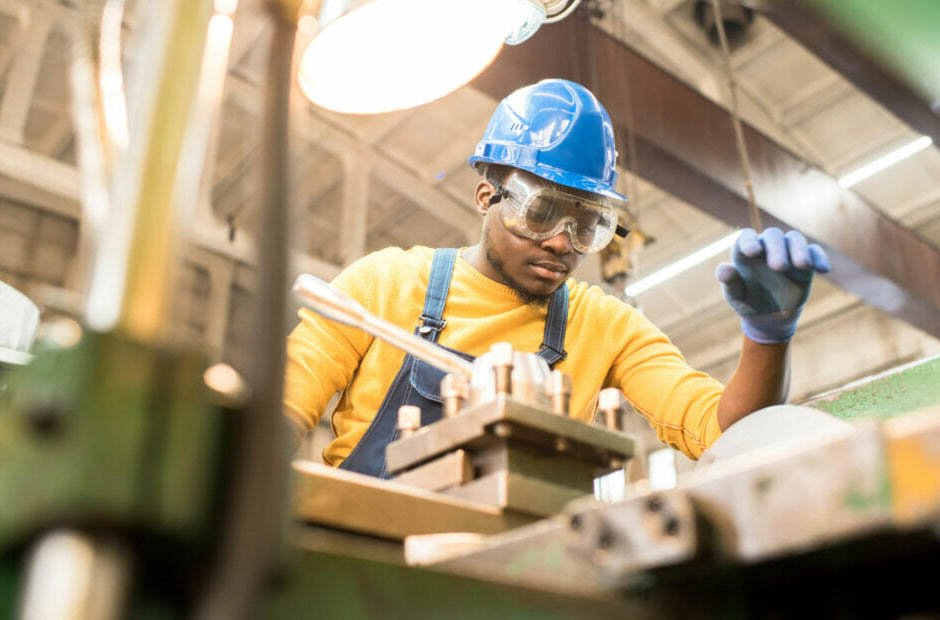
Almost 3 out of 5 workers suffering eye injuries were not wearing eye protection, or were wearing the wrong eye protection for the job. A lack of awareness? No. Ill-fitting or uncomfortable safety glasses that no one wants to wear? More likely. The same goes for overprotective bulky goggles that raise sweat between the eyes.
Fix this by doing a proper eye hazard assessment to find out what gear is comfortable and cool enough for the risks.
Start With A Physical Walkthrough, Not A Form
Before you fill in any forms, walk the floor. Do it during a live shift, not before or after. Go to every station where someone is grinding, machining, working with chemicals, or using pressurised air, and look at what is actually happening.
At each one, ask yourself two things. What could reach this person’s eyes, and how hard would it hit? A lathe chip and a grinder spark are not the same problem. One needs basic glasses, the other needs goggles rated for high-velocity impact – the “+” mark under ANSI/ISEA Z87.1. It is worth knowing that plenty of eyewear on shelves carries no rating at all, and some that does doesn’t show it clearly.
Then watch how people are actually wearing the gear. Glasses sitting on the bench, pushed up on the forehead, pulled off mid-task – that tells you more than any log will. It usually means the fit is wrong, the lenses are fogging, or something inside the frame is irritating them. You won’t see any of that from a desk.
Close The Comfort-Compliance Gap
This is where most assessments fall short. Workers remove eye protection when it fogs, distorts their vision, presses painfully against their temples, or sits awkwardly over prescription glasses. Every one of those moments is an exposure. It’s also a clue that the given frame wasn’t designed to be worn for long, or during fast-paced work.
Anti-fog coatings aren’t a premium feature in high-exertion or high-humidity environments – they’re a functional requirement. A lens that fogs during use creates a blind moment, and a worker who lifts glasses to see clearly has just negated everything the assessment was supposed to prevent.
The prescription problem deserves its own attention. Workers who need vision correction have historically been pushed toward OTG (over-the-glasses) frames, which are bulky, create fogging issues, and often don’t seal properly. A better solution is oakley prescription safety glasses or similar eyewear built to industrial standards. These are a practical example of frames that combine Z87.1+ impact ratings with wrap coverage and a fit that works with the face rather than against it – which means workers actually keep them on.
Visual acuity matters here in a direct way. A worker who can’t see clearly is a safety hazard to themselves and others, and corrective eyewear that compromises peripheral vision or optical clarity creates a second risk to manage.
Classify Hazards Before You Specify Gear
After you’ve mapped the floor, classify hazards by type. Mechanical ones – projectiles, flying debris, chips – are most common in a manufacturing setting. Chemical splash hazards necessitate D3-rated indirect vent goggles, not simply glasses, as splatter can approach the eye from below or from the side of the lens. Optical radiation from welding arcs or laser work necessitates specific shade filters that are not offered by standard polycarbonate lenses.
This is the step where the hierarchy of controls is important. PPE is the last line of defense under elimination, substitution, and engineering controls. If a machine guard or enclosed booth can get rid of the hazard, do that. The alternative – if a machine guard or enclosed booth can’t get rid of the hazard, and in most cases one can’t – needs to inform a precise PPE decision, not a generic one.
One line of difference that gets overlooked all the time: face shields are secondary protection, not primary. A worker grinding or pouring caustic chemicals needs safety glasses and a face shield. The shield alone with no glasses underneath is not going to fly, legally or safely.
Build An Inspection And Replacement Protocol
Selecting the right protective eyewear is not enough – you need to go further with the assessment. Scratched or pitted lenses degrade vision and reduce impact resistance. The same goes for stressed frames or those with even minor misalignment. If lens wearers are exposed to an eye hazard with compromised gear, they might as well not be wearing safety glasses at all. Stay ahead of the wear and tear with regular eye safety equipment check-ups.
Schedule official inspections based on the level of use that safety eyewear for your application may receive. You may wish to inspect safety glasses more often if they get heavy use – say, four times a year – just as you would routinely do with safety eyewear used in high-exposure settings. Anything that shows pitting, is scratched on the optical surface, or is cracked, is out of rotation until it’s repaired or replaced.
Getting The Assessment Right
A good eye hazard assessment, like any hazard assessment, is a risk-based process. It identifies where in the facility the need to wear eye protection exists, what level of risk those tasks create, what kind of protection will reduce the injury potential, and what other hazard control measures could be, or should be, in place to further reduce that risk.
It also has to be honest about what the workplace actually looks like on a working day, not what it looks like during an inspection. That means talking to the people doing the jobs, not just the people managing them.