
Understanding the Personal Injury Claim Process: Claim vs. Lawsuit
Navigating the aftermath of an accident can be incredibly challenging. Beyond the physical and emotional recovery, you might face a complex journey through insurance claims and legal procedures. Understanding this process is vital for protecting your rights and securing the compensation you deserve.
This extensive guide aims to demystify the personal injury claim process. We will walk you through each critical stage, from the moment an injury occurs to the potential resolution of your case. Our goal is to provide clear, actionable insights. We will cover the initial steps to take, when to seek legal counsel, and how your claim is valued. We will also explore the negotiation phase, the key stages of a lawsuit, and options for resolving disputes. Whether you are dealing with auto accident and personal injury claims or other types of incidents, knowing what to expect can bring much-needed peace of mind. Let us explore this journey together.
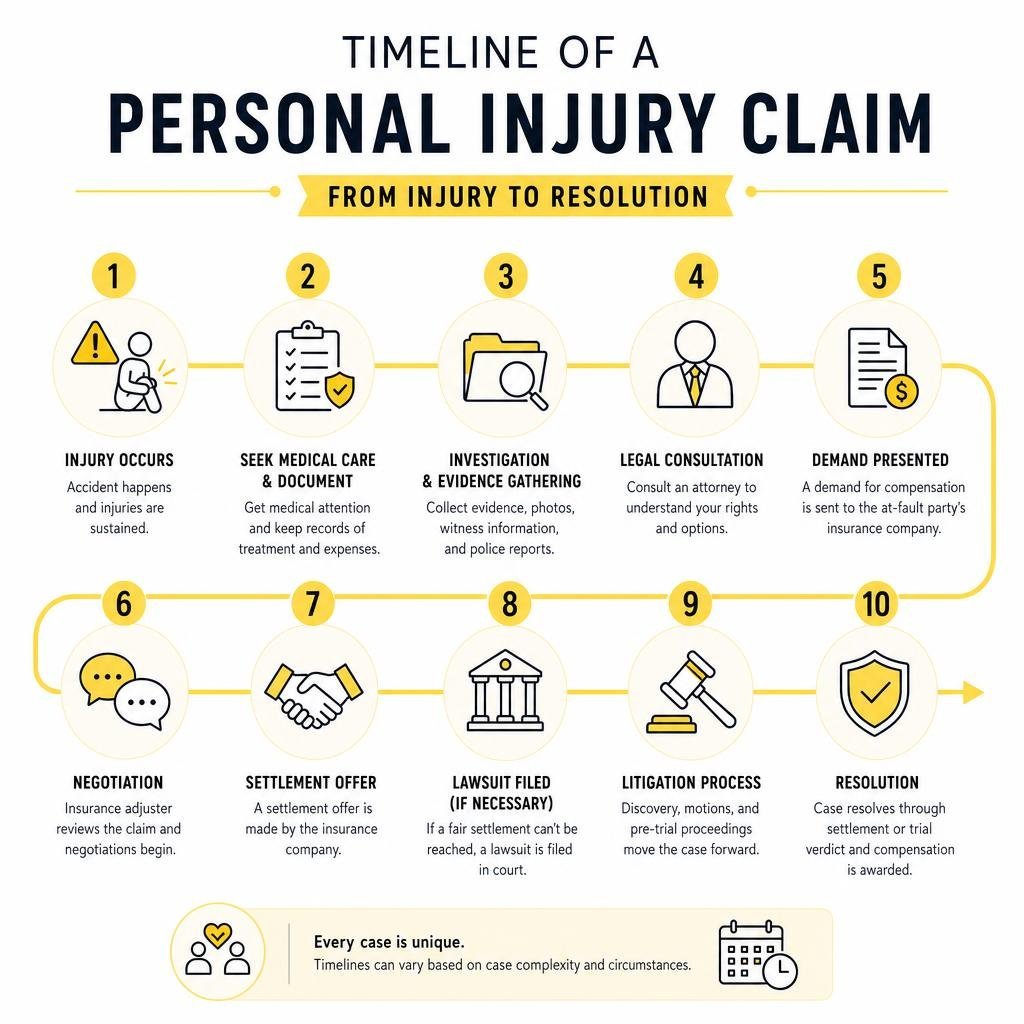
When an injury occurs due to someone else’s negligence, you might hear the terms “personal injury claim” and “personal injury lawsuit” used interchangeably. However, it’s crucial to understand that these are distinct, albeit related, concepts within the personal injury claim process.
A personal injury claim is the initial, informal demand for compensation made to the at-fault party’s insurance company or directly to the responsible individual. This phase typically involves gathering evidence, documenting damages, and negotiating with insurers. The vast majority of personal injury disputes are resolved at this stage through informal settlement negotiations. The goal here is to reach an out-of-court settlement that fairly compensates the injured party without the need for formal court proceedings.
A personal injury lawsuit, on the other hand, is a formal legal action initiated in civil court. If negotiations with the insurance company fail to produce a satisfactory settlement, or if liability is heavily disputed, the injured party (the “plaintiff”) may file a lawsuit against the responsible party (the “defendant”). This shifts the personal injury claim process from an informal negotiation to a structured legal battle governed by court rules and procedures. Filing a lawsuit does not necessarily mean a trial will occur; many lawsuits still settle before reaching a courtroom verdict. However, it signals a more serious intent to pursue compensation and often provides leverage in further settlement discussions. For those navigating the complexities of auto accident and personal injury claims, understanding this distinction is the first step toward effective advocacy.

Initial Steps in the Personal Injury Claim Process
The actions you take immediately following an injury can significantly impact the success of your personal injury claim process. Prompt and strategic steps are essential for both your health and your legal standing.
First and foremost, seek immediate medical attention. Your health is paramount. Even if you feel fine, some injuries may not manifest symptoms until hours or days later. A medical evaluation not only ensures you receive proper treatment but also creates an official record of your injuries directly linking them to the incident. This medical documentation is critical evidence in any personal injury claim. Keep a detailed account of all medical bills and associated expenses.
Next, report the incident and document the scene. If it’s a car accident, call the police to file an official report. For a slip and fall, notify the property owner or manager and ensure an incident report is created. Collect as much evidence as possible: take photos or videos of the accident scene, your injuries, vehicle damage, and any contributing factors (e.g., hazardous conditions). Gather contact information for witnesses.
It’s also crucial to preserve evidence. This includes anything related to the incident, such as damaged clothing, vehicle parts, or product packaging. Avoid discarding anything that could potentially serve as proof.
In states like Florida, understanding specific rules is vital. For instance, if you’re involved in an auto accident in areas like Clearwater or St. Petersburg, Florida’s Personal Injury Protection (PIP) laws require you to seek medical attention within 14 days of the accident to be eligible for PIP benefits. Failing to do so could jeopardize your ability to recover up to $10,000 for medical expenses and lost wages, regardless of who was at fault. This strict deadline underscores the importance of immediate action.
Finally, notify the at-fault party’s insurer (or your own, if applicable) as soon as reasonably possible. Provide a factual, brief notice of the incident, but avoid giving a recorded statement or discussing fault without first consulting an attorney. Insurance adjusters are trained to minimize payouts, and anything you say can potentially be used against you.
Statutes of Limitations and Deadlines to File
One of the most critical aspects of the personal injury claim process is adhering to the statute of limitations. This is a strict legal deadline that dictates how long you have to file a personal injury lawsuit after an injury occurs. If you miss this deadline, you generally lose your right to pursue compensation, regardless of the merits of your case.
Statutes of limitations vary significantly by state and the type of incident. For example, as of July 2026:
- In Florida, the statute of limitations for most personal injury claims based on negligence is 2 yearsfrom the date of the injury. This was recently changed from 4 years, making timely action even more crucial.
- In Pennsylvania, the statute of limitations for personal injury is generally 2 years.
- In Michigan, it is typically 3 yearsfor general personal injury claims.
These deadlines can be even shorter for specific types of claims, such as those against a government entity. Suing a government agency often requires filing a formal notice of claim within a much shorter period, sometimes as little as 60 to 180 days, before you can even file a lawsuit.
There are some exceptions to the standard statute of limitations, such as the “discovery rule.” This rule may apply when an injury or its cause is not immediately apparent. In such cases, the clock might start running from the date the injury was discovered or reasonably should have been discovered, rather than the date of the incident itself. However, applying the discovery rule can be complex and often requires legal interpretation.
Given the strictness of these deadlines and the potential for exceptions, it is always advisable to contact a personal injury attorney as soon as possible after an injury. They can determine the applicable statute of limitations for your specific situation and ensure all necessary actions are taken within the legal timeframe.
Valuing Your Case and Partnering with Legal Representation
Accurately valuing your personal injury claim is a cornerstone of the entire personal injury claim process. It involves a comprehensive assessment of all the ways the injury has impacted your life, both financially and personally. Your claim’s value will typically comprise several categories of damages:
Economic Losses (Special Damages): These are quantifiable financial losses resulting from your injury. They are often easier to calculate because they come with bills, receipts, or wage statements. Examples include:
- Medical expenses (past and future, including hospital stays, doctor visits, prescription medications, physical therapy, rehabilitation, and assistive devices).
- Lost wages (income lost due to time off work, as well as future lost earning capacity if the injury prevents you from returning to your previous job or working at all).
- Property damage (e.g., repair or replacement costs for your vehicle in a car accident).
- Out-of-pocket expenses (e.g., transportation to medical appointments, household help you had to hire).
Non-Economic Impacts (General Damages): These are subjective, non-monetary losses that are harder to quantify but significantly impact your quality of life. They are often determined by a jury or through negotiation based on the severity and permanence of your injuries. Examples include:
- Pain and suffering (physical discomfort and emotional distress).
- Emotional anguish (anxiety, depression, fear, PTSD).
- Loss of enjoyment of life (inability to participate in hobbies, activities, or daily routines you once enjoyed).
- Loss of consortium (impact on marital or family relationships).
- Disfigurement or permanent impairment.
Punitive Damages: In rare cases, if the at-fault party’s conduct was exceptionally reckless, malicious, or grossly negligent, a court might award punitive damages. These are not intended to compensate the victim but rather to punish the wrongdoer and deter similar conduct in the future. Punitive damages are typically capped by state law and are much less common than economic and non-economic damages.
Here’s a comparison of economic and non-economic damages:
Category Description Examples Proof Required
Economic Losses
Tangible, objective financial costs directly resulting from the injury. Medical bills, lost wages, property repair costs, rehabilitation expenses, transportation for treatment. Receipts, invoices, pay stubs, employment records, expert testimony (for future losses).
Non-Economic Impacts
Intangible, subjective losses that affect quality of life and well-being. Physical pain, emotional distress, mental anguish, loss of enjoyment of life, disfigurement. Medical records detailing injury severity, psychological evaluations, personal testimony, witness statements, journal entries, expert medical opinions.
When to Hire an Attorney and How Contingency Fees Work
Deciding when to hire a personal injury attorney is a critical decision in the personal injury claim process. While you are legally allowed to pursue a claim on your own, having experienced legal counsel can significantly impact your outcome, especially if your injuries are severe, liability is disputed, or the insurance company is uncooperative.
We recommend seeking a legal consultation as soon as possible after an accident. Many personal injury attorneys offer free initial consultations, allowing you to discuss your case without financial commitment. During this meeting, an attorney can provide a preliminary case evaluation, explain your legal options, and advise you on the best course of action. This early consultation also helps establish attorney-client privilege, ensuring your discussions remain confidential.
One of the most compelling reasons to hire a personal injury lawyer is their fee structure: the contingency fee basis. This means your attorney’s fees are contingent upon them winning your case, either through a settlement or a court award. If they don’t secure compensation for you, you generally don’t pay them legal fees. This arrangement makes quality legal representation accessible to everyone, regardless of their financial situation after an injury.
Typically, the contingency fee is a pre-agreed percentage of the final settlement or judgment, commonly around one-third (33%) of the recovery. This percentage can vary depending on whether the case settles before a lawsuit is filed, after a lawsuit is filed but before trial, or if it goes to trial. Additionally, clients are usually responsible for case expenses (e.g., court filing fees, expert witness fees, medical record costs), which are often paid back from the settlement amount.
An attorney brings invaluable expertise to the personal injury claim process. They can:
- Investigate the accident thoroughly and gather crucial evidence.
- Negotiate with aggressive insurance companies on your behalf.
- Accurately value your claim, ensuring all damages are considered.
- Handle all legal paperwork and adhere to strict deadlines.
- Represent you in court if a settlement cannot be reached.
For individuals or families grappling with the aftermath of an injury, having dedicated legal support can make all the difference. Firms specializing in representing accident victims understand the nuances of personal injury law and are committed to fighting for fair compensation.
The Negotiation Phase: Demand Letters and Settlements
Once your injuries have stabilized and you’ve reached what is known as Maximum Medical Improvement (MMI)—meaning your condition is unlikely to improve further, though you may still require ongoing care—your attorney will typically prepare a demand letter. This is a crucial step in the personal injury claim process.
A demand letter is a formal document sent to the at-fault party’s insurance company. It outlines the facts of the accident, establishes liability, details your injuries, summarizes your medical treatment, itemizes all economic and non-economic damages, and concludes with a specific monetary amount requested for settlement. This letter is backed by all the evidence gathered, including medical records, bills, police reports, witness statements, and lost wage documentation.
Upon receiving the demand letter, the insurance company’s insurance adjuster will review the claim. Their primary goal is often to settle for the lowest possible amount. They may respond with a low initial offer or even deny the claim outright. This marks the beginning of the negotiation process.
Negotiations can involve several rounds of offers and counteroffers. Your attorney will leverage their experience and the strength of your evidence to advocate for a fair settlement. They will explain why the insurer’s offer is inadequate and present compelling arguments for a higher amount. During this phase, it’s essential not to accept any offer without consulting your attorney, as accepting a settlement typically requires you to sign a settlement release, which is a legal document waiving your right to pursue further legal action related to that incident.
Many personal injury claims settle during this negotiation phase, avoiding the need for a lawsuit. However, if the insurance company remains unwilling to offer a fair settlement, your attorney may advise you that it’s time to consider filing a lawsuit to push the case forward.

Moving to Litigation: Key Stages of a Personal Injury Lawsuit
If negotiations fail to yield a satisfactory settlement, the personal injury claim process transitions into formal litigation. This means filing a lawsuit in civil court. While many lawsuits still settle before trial, understanding these stages is crucial for anyone pursuing justice through the legal system.
The first step in litigation is filing a civil complaint (sometimes called a “petition”) with the appropriate court. This document formally outlines the legal and factual basis of your lawsuit, identifying the parties involved, describing the incident, detailing your injuries and damages, and stating the legal theories under which you are seeking compensation.
Once the complaint is filed, the court issues a summons. The summons is a formal notice to the defendant that a lawsuit has been filed against them. The plaintiff is then responsible for service of process, which involves legally delivering the summons and a copy of the complaint to the defendant. This must be done according to specific court rules, often by a professional process server or law enforcement officer, and within a certain timeframe (typically 60 to 120 days after filing). Proper service ensures the defendant is officially notified and has an opportunity to respond.
After being served, the defendant has a limited time (usually 20 or 30 days, depending on the jurisdiction) to file an answer to the complaint. In their answer, the defendant will respond to each allegation in the complaint, typically admitting, denying, or stating they lack sufficient information to respond. They may also raise affirmative defenses, which are legal arguments that could reduce or eliminate their liability.
This initial pleading stage sets the framework for the entire lawsuit. It officially brings the dispute into the court system and initiates the formal legal proceedings that will ultimately lead to a resolution, whether through further settlement, mediation, or a trial. For serious cases, such as those handled by a wrongful death law firm, these initial litigation steps are particularly critical in establishing the foundation for complex claims.
How the Discovery Phase Impacts the Personal Injury Claim Process
Following the initial pleadings, the personal injury claim process enters the discovery phase. This is a crucial and often lengthy period where both sides exchange information and gather evidence to prepare for trial or settlement negotiations. The primary goal of discovery is to prevent surprises at trial and allow each party to understand the strengths and weaknesses of the opposing side’s case. The discovery process can take up to one year, depending on the complexity of the case.
Key discovery tools include:
- Written Discovery: This involves formal written questions and requests for documents.
- Interrogatories: These are written questions sent by one party to another, which must be answered under oath. They seek factual information about the incident, injuries, medical treatment, witnesses, and damages.
- Requests for Production of Documents (RFPs): These are formal requests for specific documents, such as medical records, bills, employment records, insurance policies, accident reports, photographs, videos, and communications.
- Requests for Admissions: These ask the opposing party to admit or deny certain facts or the authenticity of documents, helping to narrow down the issues in dispute.
- Depositions: A deposition is a sworn, out-of-court testimony taken from a witness or party involved in the lawsuit. During a deposition, attorneys from both sides question the deponent under oath, with a court reporter present to transcribe the testimony. Depositions serve multiple purposes: they gather facts, allow attorneys to assess how a witness might perform at trial, and “lock in” a witness’s testimony, making it difficult for them to change their story later.
- eDiscovery (Electronic Discovery): In our increasingly digital world, eDiscoveryhas become a standard component of document production. This involves the identification, collection, and production of electronically stored information (ESI) as evidence. ESI can include emails, text messages, social media posts, GPS data, digital photos, videos, and data from electronic devices. Attorneys use specialized tools and forensic experts to manage and analyze this vast amount of digital evidence, ensuring all relevant information is preserved and produced.
The discovery phase is labor-intensive and requires meticulous attention to detail. It’s where the true strength of each party’s case is revealed, often leading to more realistic settlement discussions.
Resolving the Dispute: Mediation, Trial, and Collecting a Judgment
Even after the extensive discovery phase, the personal injury claim process still offers various avenues for resolution. Most cases don’t go to trial; instead, they are resolved through alternative dispute resolution methods or further settlement negotiations.
One common method is mediation. In mediation, a neutral third-party mediator (often a retired judge or experienced attorney) facilitates discussions between the parties. The mediator does not make decisions but helps the parties explore common ground, understand each other’s positions, and work toward a mutually acceptable settlement. Mediation is confidential and non-binding, meaning the parties are not forced to accept an offer. If a settlement is reached, it is put into writing and becomes a legally binding agreement.
If mediation and further negotiations fail, the case may proceed to trial. A personal injury trial is a formal court proceeding where both sides present their evidence and arguments to a judge or jury.
- Jury Selection: If it’s a jury trial, attorneys for both sides participate in selecting impartial jurors.
- Opening Statements: Each side presents an opening statement, outlining what they intend to prove.
- Witness Testimony and Evidence: Attorneys call witnesses to testify and introduce evidence (documents, photos, expert reports). Witnesses are cross-examined by the opposing side.
- Closing Arguments: After all evidence is presented, attorneys deliver closing arguments, summarizing their case.
- Verdict: The jury (or judge, in a bench trial) deliberates and delivers a verdict, determining liability and the amount of damages. A personal injury trial can range from several weeks to several months in length, depending on the complexity.
If you win at trial and are awarded a judgment, the final step is collecting a judgment. While a judgment is a legal order, it doesn’t automatically mean money appears in your bank account. If the defendant or their insurance company doesn’t voluntarily pay, you may need to take additional legal steps to enforce the judgment. This can include:
- Wage garnishment: A portion of the defendant’s wages is withheld to pay the judgment.
- Bank account levies: Funds are seized directly from the defendant’s bank accounts.
- Property liens: A lien is placed on the defendant’s real estate or other assets, which can be sold to satisfy the judgment.
Finally, either party may choose to pursue an appeals process if they believe there were significant legal errors during the trial. An appeal is a request to a higher court to review the trial court’s decision. Appeals can add years to the personal injury claim process and are often complex and costly.
Frequently Asked Questions About Personal Injury Claims
We understand that the personal injury claim process can raise many questions. Here are answers to some of the most common inquiries we receive:
Can I still recover damages if I was partially at fault for the accident?
Yes, in most states, you can still recover damages even if you were partially at fault for the accident. The legal principle that governs this is called comparative negligence. Most states follow a system of modified comparative fault, where your financial recovery is reduced by your percentage of fault. For example, if a jury determines your total damages are $100,000, but you were 20% at fault, your award would be reduced to $80,000. Many states, including Florida, also have a threshold for recovery; if you are found to be more than 50% at fault, you may be barred from recovering any damages. A few states still use pure contributory negligence, which completely bars recovery if you bear any percentage of fault. An attorney can help you understand how comparative negligence rules apply to your specific case and how they might impact your potential recovery.
How long does the entire personal injury claim process typically take?
The timeline for a personal injury claim can vary significantly, ranging from a few months to several years. Simple claims with clear liability and minor injuries that settle quickly might conclude in 3-6 months. However, cases involving serious injuries, complex liability disputes, or extensive medical treatment (requiring you to reach Maximum Medical Improvement) will naturally take longer. If the case proceeds to litigation, the litigation duration can add one to three years to the process, especially with the discovery phase sometimes taking up to a year on its own. Factors influencing the timeline include the severity of injuries, the willingness of insurance companies to negotiate fairly, court backlogs, and the need for expert witnesses. Patience, combined with proactive legal representation, is often key.
Are personal injury settlements taxable under federal law?
Generally, no, personal injury settlements for physical injuries or sickness are not taxable under federal law. The IRS tax code (specifically Section 104(a)(2)) typically excludes compensation received for physical injuries or physical sickness from gross income. This means that the portion of your settlement allocated to medical expenses, lost wages directly related to physical injury, and pain and suffering is usually non-taxable compensation. However, there are exceptions. Punitive damages, which are awarded to punish the at-fault party rather than compensate the victim, are typically taxable. Additionally, any portion of a settlement allocated to emotional distress not stemming from a physical injury, or interest earned on a settlement, may also be taxable. It’s always wise to consult with a tax professional regarding the specifics of your settlement to ensure compliance with tax laws.
Conclusion
The personal injury claim process is a multifaceted journey, often fraught with legal complexities and emotional challenges. From the immediate aftermath of an accident to potential courtroom battles, every step requires careful consideration and strategic action. Understanding the distinction between a claim and a lawsuit, adhering to critical deadlines like the statute of limitations, and accurately valuing your damages are all essential for protecting your rights.
While the process can seem daunting, you don’t have to navigate it alone. Seeking experienced legal counsel can provide invaluable guidance, ensuring you meet all requirements, effectively negotiate with insurance companies, and, if necessary, vigorously represent your interests in court. Our goal is to empower you with the knowledge needed to make informed decisions and secure the compensation you deserve, allowing you to focus on your recovery and regain your peace of mind.